Finding the Right Urban Edge for Your Project
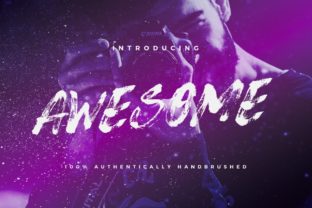
You’re staring at a design, a brand idea, or a personal project and you know it needs something. It needs texture. It needs a voice that’s bold but not shouty, confident but not sterile. It needs a touch of the street, of the handmade, of something that feels authentic. This is where a font like Awesome comes into play. Awesome is a 100 hand-lettered dry brush script that captures a bold and urban feel perfectly. It’s not just another script font; it’s a collection of unique, hand-drawn characters that bring the raw energy of brush strokes to your digital work.
The Pulse of Hand-Lettering in a Digital World
We live in a world of perfect vectors and clean Helvetica, but often, the projects that stand out carry a human fingerprint. Awesome provides that fingerprint. Each letter feels like it was laid down with a physical brush, with natural variations in thickness, texture, and flow. This isn’t a flaw—it’s the core feature. When you use Awesome, you’re injecting a dose of crafted humanity into a space that can often feel overly polished and impersonal.
Where That Urban Feel Makes a Real Difference
So, where does this actually matter? Let’s move past the abstract and look at the real situations.
Imagine a local coffee shop that roasts its own beans and wants a logo that feels as artisan as its product. A sleek, modern font might contradict their hands-on ethos. Using Awesome for their shop name on signage and menus immediately communicates craftsmanship and grounded energy. It connects visually with the tactile experience of grinding beans and pouring a drink.
Or consider an independent musician releasing an EP. Their sound is gritty, rooted in real-life stories. Using Awesome for the album title on the cover art and promotional posters creates a visual harmony with the music’s raw, emotional content. It tells the audience, before they even hear a track, that this comes from a real place.
Even in the digital realm, this texture translates. A blogger writing about urban gardening, DIY home repairs, or street photography might find their site’s headline or featured post titles feel bland. Introducing Awesome for those key visual anchors can set the tone for the entire site, suggesting a content style that’s hands-on, authentic, and unpretentious.
More Than Just Logos: Diverse Applications Across Projects
The use cases for Awesome extend far beyond a single logo lockup. Its versatility lies in its ability to serve as a powerful accent within larger systems.
For the Entrepreneur and Small Business Owner
A small business owner launching a line of handmade leather goods needs a cohesive brand identity. They might use a clean, readable sans-serif for most of their website text and product descriptions for clarity. But for the brand name itself, and for short, impactful phrases like “Hand-Stitched” or “Built to Last” on product tags and packaging, Awesome becomes the signature. It ties the visual brand directly to the physical, handmade nature of the products, reinforcing the core value proposition at every touchpoint.
For the Creative Freelancer and Marketer
A freelance graphic designer or social media marketer curating a campaign for a client with an adventurous, active brand—say, a skateboard shop or an outdoor apparel company—needs assets that pop. Using Awesome for key campaign slogans in Instagram graphics, YouTube video titles, or email header images can instantly grab attention and convey a mood of dynamic, gritty action. It helps the campaign visuals stand out in crowded feeds where overly smooth and corporate designs often blend together.
For Educators, Publishers, and Hobbyists
An educator creating a workshop booklet on urban art history, or a hobbyist publishing a zine about model kit customization, wants their materials to resonate with the subject matter. Using a dry brush script like Awesome for chapter titles or section headers within a otherwise cleanly typeset document adds a thematic layer. It visually signals the content’s connection to manual creation, street culture, or raw artistic expression, making the material feel more integrated and engaging.
What to Consider Before Using Awesome
Because Awesome has such a distinct personality, it’s not a universal solution. Applying it effectively requires some thoughtful consideration.
First, assess the overall tone of your project. Awesome carries an urban, bold, and handcrafted feel. It might clash with a project requiring elegance, serenity, or high-tech precision. It’s perfect for brands and projects that want to feel accessible, grounded, energetic, or artistic.
Second, think about its role in your design hierarchy. Awesome is often strongest as a display font—used for headlines, logos, short phrases, and accents. Its intricate brush details can become challenging to read at very small sizes or in long paragraphs. Pairing it with a more neutral, legible font for body text is a common and effective strategy. This creates balance: the Awesome font provides the character and mood, while the supporting font ensures clear communication.
Third, consider the medium. Awesome’s texture shines both digitally and in print, but its impact can vary. On a textured print material like uncoated cardstock or a kraft paper bag, the font’s dry brush look can feel incredibly tangible and authentic. On a sleek website, it provides a striking contrast to the digital environment, drawing the eye precisely because it feels so physical.
Connecting Features to Real Outcomes
It’s helpful to move past simply listing “100 hand-lettered characters” and see what that means in practice. This variety means you won’t get a repetitive, mechanical look when you type a word. The natural variation mimics real hand-lettering, so a word like “Awesome” itself will have a unique, organic rhythm in its strokes. This leads to an outcome: your design feels custom-made, not assembled from a standard template. The “bold and urban feel” isn’t just a tagline; it’s the result of those heavy brush strokes and gritty texture, which directly communicates strength, confidence, and streetwise authenticity to your viewer.
Tailoring Its Use to Your Specific Needs
The benefit of Awesome changes depending on who you are and what you’re doing.
For a blogger focusing on urban lifestyle, it helps establish a visual theme that matches their written content, building a stronger, more coherent brand for their site. For a marketer, it’s a tool to cut through visual sameness and anchor a campaign with memorable, mood-setting typography. For a small business owner, it acts as a visual shorthand for their product’s handmade quality, potentially strengthening customer perception and loyalty. For a hobbyist or educator, it adds an layer of appropriate aesthetic engagement to their projects, making them more enjoyable to create and to consume.
In every case, the core value is the same: Awesome provides a specific, high-quality visual tone that is difficult to achieve with standard, geometric fonts. It allows individuals and businesses to express a particular kind of authenticity—one that’s bold, human, and rooted in the physical world—within their digital and print communications. When your project calls for that edge, that texture, that voice, finding the right typeface isn’t just a detail; it’s central to the message. And for that specific message, Awesome offers a compelling and ready-made solution.